I was wrestling with all sorts of methods for connecting information. I wanted to bridge different disciplines: computer science and AI, educational sciences, cognitive psychology, systems thinking and futures studies, philosophy of knowledge, and personal knowledge management. Each had its own vocabulary for what seemed like essentially the same problem: how do you organize knowledge so it’s actually useful later, and so you learn from it? They’re just slightly different, but also quite similar. I wanted to somehow determine how they differ or overlap, and whether we can learn from other methods.
When you’re absorbed in a topic, it’s often hard to think outside your own bubble. This applies both when you’re reading about a subject and when you’re trying to tell your own story. In the end, it helped to simply draw it. Two questions seemed most distinguishing:
- Does the method focus on what you capture (the nodes, the individual ideas) or on how you connect (the relationships between them)?
- Does the method work visually or through text?
![[Online Breinpaleis/Notes/Images/Methoden voor verbinden.png]]
The result is the figure above. Zettelkastens and indexes land in the lower-left and lower-right: text-based, one focused on individual notes, the other on connections. Mind mapping and knowledge graphs on the right and upper-left. The matrix didn’t force me to choose which method was best. It forced me to understand what they actually did.
This method helps me look differently at the ideas I want to understand. Quite meta, by the way: this method appears in its own graph, under visual nodes: creating charts and figures. The tool sits inside the system it describes.
There are quite a few of these matrices out there. The most well-known is the Eisenhower Matrix, which divides work into urgent and not urgent, important and not important. That produces four quadrants telling you what to do with your work.
## The Breinpaleis Blueprint
The Breinpaleis Blueprint is organized the same way. I defined two axes: zooming in and out, and knowledge versus management (or understanding versus doing — this is still evolving). This visualization covers everything I do within my Breinpaleis, showing that there are fundamentally different types of work.
![[Breinpaleis Blueprint.png]]
## When two axes aren’t enough
I read an article from the [Artificiality Institute](https://journal.artificialityinstitute.org/cognitive-sovereignty-and-the-cube/) that took this a step further. They built not a plane but a cube, with three axes describing how AI relates to your thinking.
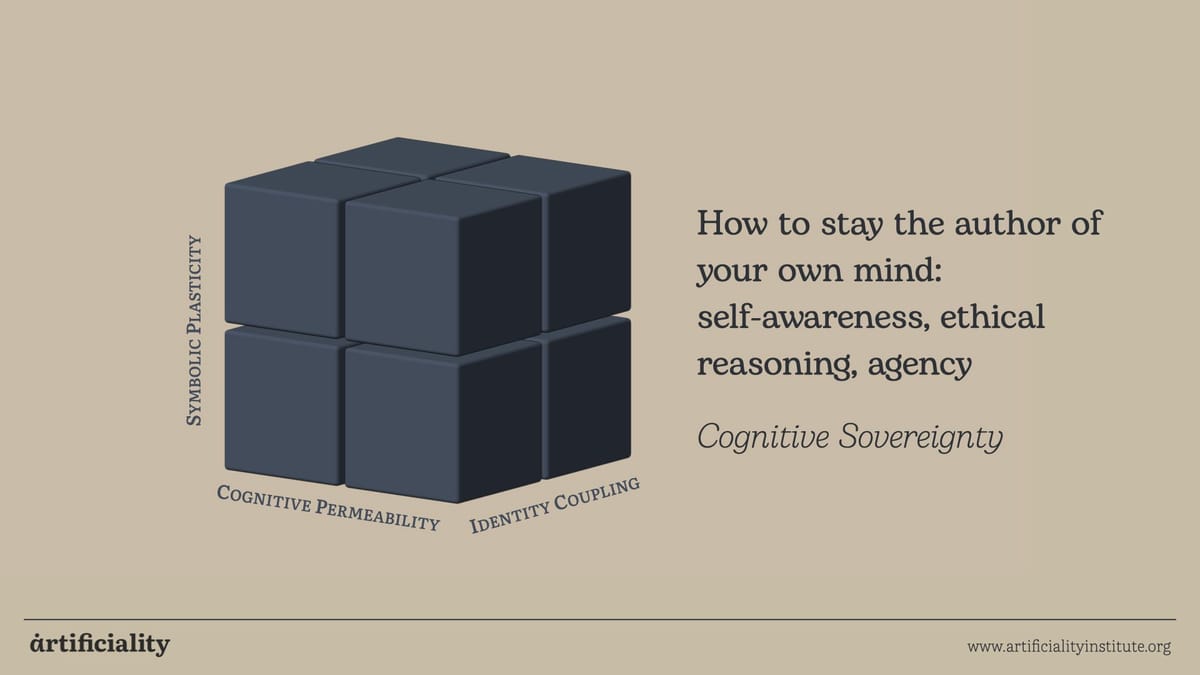
Three axes played a role:
**Cognitive permeability** concerns the degree to which AI penetrates your thinking process. Do you mainly use AI as an execution tool, or do you let it co-think, structure, and suggest conclusions?
**Symbolic plasticity** describes how strongly AI shapes your world of meaning. Does AI stay within your existing language and concepts, or does it introduce new frames, metaphors, and categories that change how you understand things?
**Identity coupling** examines the relationship between AI and your self-image. Is AI an external instrument you use, or does it become part of how you define yourself as a knowledge worker, expert, or maker?
This yields eight types of knowledge workers instead of four. That’s certainly more refined. But I also notice I need to sit down and study the cube to understand it, whereas I grasp the 2D matrix in a single glance. The gain in nuance costs something in accessibility. Or put differently: three axes describe reality better, but two axes help you move through it faster.
I think I’ll stick with two axes for now, but experimenting with a third can certainly do no harm.
## Does this fit in your own brain palace?
How do you start, and how do you know which axes to use?
I think it starts with gathering. Throw everything you have on a topic together without judging. Write it down, make it visual, see what you have.
Then look for differences. What makes this item different from that one? That tension is your axis.
Once you have a candidate axis, check whether everything you’ve gathered actually fits on it. Is there something left over that doesn’t land anywhere? Then you’ve probably found a second axis, or you need to adjust the first.
And then you start again. You place everything anew, check whether it holds, and adjust where needed. Until the structure feels like something that genuinely helps you understand or explain the topic.